
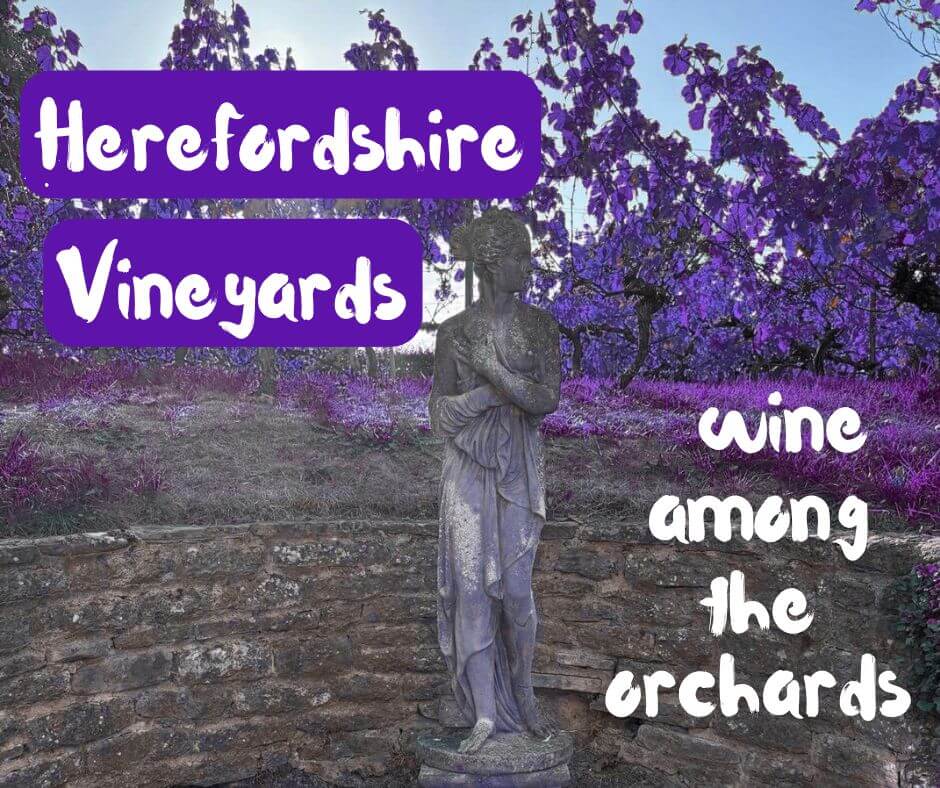
For centuries, Herefordshire has grown apples, pears and hops destined for our glasses. Now grapes are joining them. We tour three Herefordshire vineyards to see how wine is finding its place in the landscape.
[This article was produced in paid partnership with Visit Herefordshire. Slake was hosted for the trip featured in this article.]
“Apples or army?”
When Herefordshire locals meet someone new, I’m told this is one of the questions they ask. In other words: do they belong to the county’s world of orchards and cider, or have some connection to the SAS, headquartered just outside Hereford?
Spend any time travelling through Herefordshire and the importance of the first becomes obvious. Herefordshire is green, gently rolling and unmistakably agricultural: livestock in the fields, orchards alongside the roads and, every so often, the great scaffolding-like structures of a hopyard.
Then there is May Hill. Sitting on the Herefordshire-Gloucestershire border, its summit is instantly recognisable by its crown of pine trees. Most standing today were planted to mark Queen Victoria’s Golden Jubilee in 1887, replenishing an earlier stand.
Another orchard fruit also has particularly deep roots here. An old saying has it that a perry pear tree grows best within sight of May Hill, while local folklore offers a mythical explanation for their abundance. According to the tale, at the dawn of the world a group of immortals gathered on the hill to admire their handiwork. Their chief was offered a perry pear, bit into the famously tannic fruit and promptly spat it out, scattering the pips across the surrounding countryside.
A more terrestrial explanation involves rather more soil and rather fewer gods, but the story says something about how deeply fruit and drink are woven into this landscape.
Herefordshire’s documented fruit-growing story can be traced to at least the 14th century. By 1724, Daniel Defoe – novelist, travel writer and author of Robinson Crusoe – wrote in A Tour Through the Whole Island of Great Britain that the county’s people boasted, “perhaps not without reason”, of having the “best hops and richest cider in all Britain”.
Three centuries later, apples and hops remain part of the landscape, but the list of what Herefordshire grows for our glasses has got longer – and I’m here for the weekend to check it out.
From blackcurrants to grapes
At White Heron Estate, that list includes blackcurrants and, since 2020, grapes. The same family has farmed here since 1876, although anyone imagining a small pastoral operation should recalibrate. Today there are 150 acres of blackcurrants (supplying Ribena), 55 acres of cider-apple orchards (supplying Bulmers and others) and 35 acres of vines, alongside a significant poultry operation (supplying Nandos and supermarkets).
For Jo Hilditch, who took over the family business following the death of her father Richard in 1997, diversification has been a recurring theme.
In 2005, with a glut of blackcurrants Hilditch began experimenting with a British take on crème de cassis. The blackcurrants are pressed and the juice fermented before being fortified with vodka and sweetened with sugar (traditionally, French crème de cassis is made by macerating blackcurrants in alcohol rather than fermenting them). The result is intensely fruity, with the berries’ natural acidity cutting through the sweetness. A raspberry Framboise followed.
Fifteen years later came another diversification: vines.
Hilditch is matter-of-fact about what prompted them: Covid happened, she was bored, and there was an opportunity. The choices that followed were equally practical. The vineyard includes Seyval Blanc, Madeleine Angevine and Reichensteiner, varieties chosen for their ability to ripen reliably in Britain’s cool climate.
White Heron’s sparkling wine is made using the Charmat method, the same process used for Prosecco. The result is a pleasingly lively fizz and, with a splash of the estate’s cassis, the makings of a very British Kir Royale — a Kir Britannique, if you will.
Our Saturday begins on e-bikes, riding between vines, orchards and blackcurrant fields with the smell of freshly cut grass in the air and birdsong all around us. White Heron is particularly proud of the latter: its annual farmland bird count has recorded 130 different species, helped by wildflower field margins, bird-food crops, less frequent hedge cutting and more than 50 bird boxes across the farm.
Afterwards, a bowl of crisps accompanies a tasting of the range, before we climb into a minibus and head east.

The vineyard with a 750-year-old name
An hour or so later, we arrive at 1276 Wines – a recently adopted name inspired by a very old piece of paperwork.
The Bishop of Hereford’s “Red Book”, so called due to the red leather rebinding, is a 13th-century survey of the bishopric’s estates. It in are records of vines being planted on the south-facing Wall Hills of Ledbury in 1276. In other words, more or less where we’re standing now.
Inside the winery, we’re firmly back in the 21st century. We move among tanks, hoses and equipment, tasting wines straight from the tanks at different stages of development – a chance to taste the winemaking rather than simply the finished product.
The finished bottles appear over lunch, paired with local cheeses, charcuterie and various nibbles. The Chardonnay is particularly good, with a lovely weight and texture – a view seemingly shared by the International Wine Challenge judges, who awarded the 2024 vintage the English White Trophy in 2026. The sparkling rosé impresses too, with enough ripe fruit to stand up surprisingly well to a slice of Victoria sponge.
Learning among the vines
Our final stop is Frome Valley, which makes quite a different first impression. We arrive in a courtyard with a 16th-century farmhouse straight ahead, old sheds tucked off to the left and a dedicated visitor room to the right. Behind it is a miniature vineyard, planted with vines trained in several different ways.
It’s here that owner Jeanie begins our tour, using the rows to explain how pruning and training affect the way a vine grows and the grapes it produces. Seeing the different methods side by side makes what could easily become a technical lesson surprisingly easy to follow. From there, we cross the field to the main vineyard.
There are more experiments among the vines. Sheep’s wool is tucked around their bases to suppress weeds, while a tea made from worm castings is used in an effort to reduce spraying.
Jeanie explains the thinking as we walk, accompanied by the vineyard’s two dogs -including the particularly cheeky Lyra, who at one point abandons any pretence of personal boundaries and settles fully into my lap. I’d like to think it was affection; the food nearby was probably the more persuasive draw.

Wine isn’t their whole story. There’s perry, and then two brandies made from a blend of all the grape varieties in the vineyard – my favourites of theirs – ranging from fruity and honeyed to nutty, with caramel and fudge notes.
Heading back to our accomadtion in White Heron, we’ve spent a fair amount of the day on Herefordshire’s roads. The three vineyards aren’t neighbours, but travelling between them gives us a good look at the county in between. We detour through some of its Black and White Villages, named for the centuries-old timber-framed houses lining their streets, many dating from the 16th and 17th centuries or earlier. It’s strange to think that the people who lived in them would have been drinking from the same landscape too -even if the varieties and methods have changed considerably since.
Dinner is being cooked over a fire pit beside the vineyard. By happy coincidence, it’s a full moon and a clear night, the vines dappled in moonlight. We take our places around a long table as dishes come straight from the flames.
Centuries of orchards, hopyards and, now, vineyards have brought us here. Tonight, the story ends where it probably should: eating together, with much of the county being poured into our glasses.
How to go wine tasting in Herefordshire
Herefordshire’s vineyards are scattered across the county, so visiting several in one trip takes some planning.
The trip that brought me here was A Wine Tour of Herefordshire – Ancient Roots, Fresh Vintage, a collaboration between White Heron Estate, 1276 Wines and Frome Valley Vineyard.
The two-night break is based in self-catering accommodation at White Heron and costs £555 per person, based on two people sharing. Breakfast hampers are provided, while the full vineyard-touring day includes tastings, lunch, dinner among the vines and minibus transport between the three estates. There’s also a choice of an e-bike or walking tour around White Heron’s working farm.
Dinner isn’t included on the first evening, so guests will need to use the self-catering kitchen or head out to one of the area’s pubs or restaurants.
The tasting day can also be booked without accommodation for £255 per person, including vineyard visits, tastings, food and transport from White Heron.
The remaining 2026 dates run until 21 October, with further dates expected between mid-May and mid-July and again from September to October 2027.
Book the tour – https://whiteheronestate.com/tours/a-wine-tour-of-herefordshire/
This tour is featured in Visit Herefordshire’s vineyard safari – a self guided trail offering suggestions of how to explore the county’s vineyards with suggested walks, tastings, events and places to stay all with a wine theme. www.visitherefordshire.co.uk/wine
More from Slake
Fancy more drinking your way around the world? Explore our travel stories, from vineyard visits and local guides to places worth raising a glass in.